
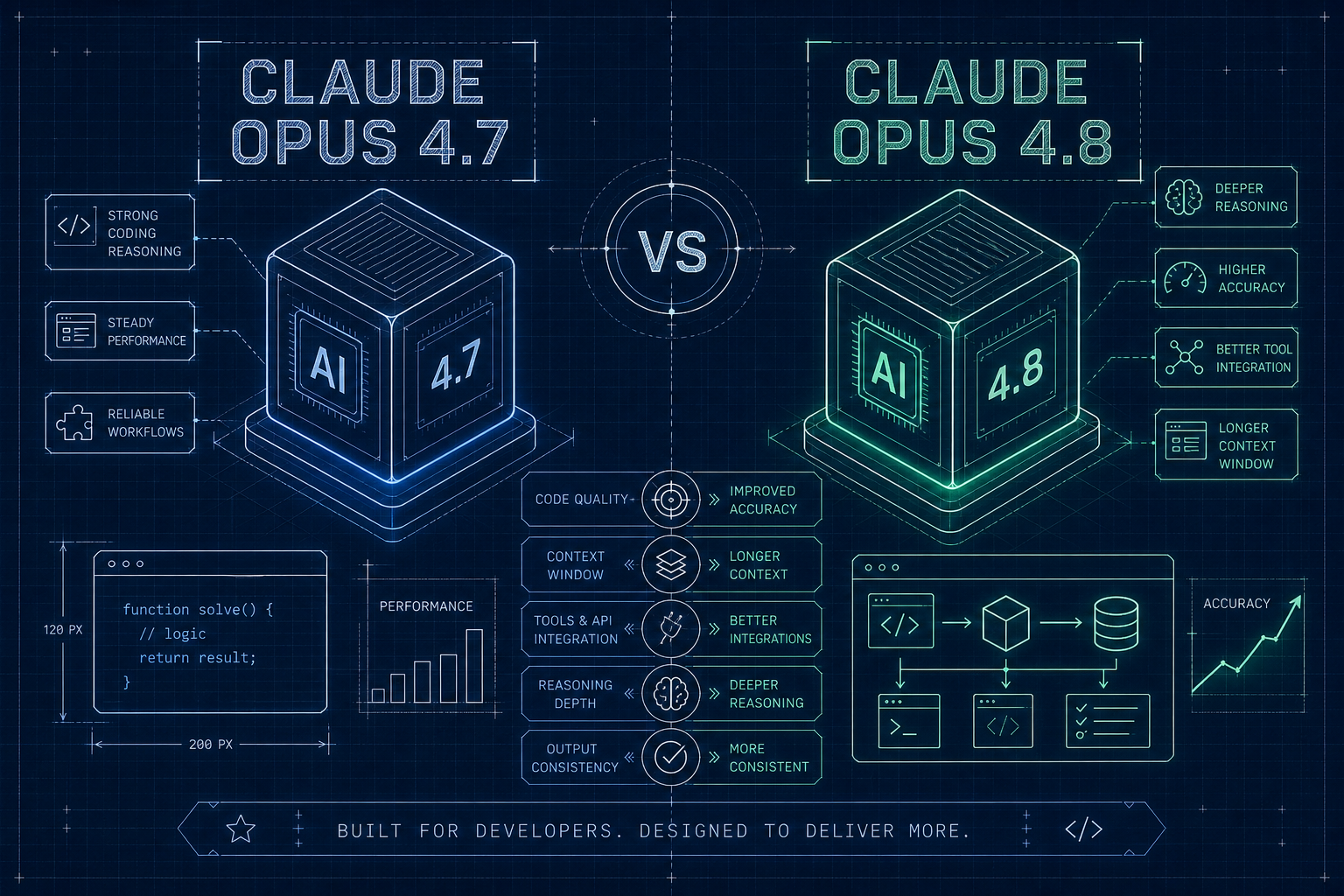
Anthropic released Claude Opus 4.8 on May 28, 2026, and the launch announcement follows the familiar pattern: “most capable generally available model yet,” stronger agentic performance, better reasoning calibration. Those claims are easy to publish and harder to evaluate from the outside. The real question for a developer already running Opus 4.7 in production isn't whether 4.8 is technically better on a marketing benchmark, it's whether it's meaningfully better for the specific workloads running in your environment right now. This article compares claude opus 4.8 vs 4.7 across the dimensions that actually matter: changelog, independent benchmarks, behavioral shifts, cost math, and a concrete decision framework.
The team at Claudinhos runs independent experiments on Claude models that go beyond what Anthropic's release notes cover, which is where the observations in this article come from. What follows is a direct comparison covering behavioral shifts that affect production code, the actual cost math, and a framework for deciding whether to upgrade now or wait.
What actually changed in the 4.8 release
The most architecturally significant change is the replacement of Opus 4.7's xhigh effort tier with adaptive thinking. In 4.7, xhigh was the headline reasoning upgrade: a fixed-intensity reasoning level designed for the hardest agentic tasks. Opus 4.8 replaces that with a system where reasoning triggers based on what the task actually requires, rather than running at a consistent high intensity regardless of complexity. The default effort level is now high, and the model decides when to scale up from there.
In practical terms, this means 4.8 won't burn thinking tokens on a simple lookup the way a forced xhighcall in 4.7 might. For developers who've been tuning effort levels carefully to manage token spend on mixed-complexity workloads, this shift changes the calculus. You get more variable reasoning token consumption that tracks task difficulty rather than a uniformly expensive compute ceiling.
The context window ships at 1M tokens by default, with 128k max output tokens. Microsoft Foundry remains at 200k context. On the API surface, mid-conversation system messages now work in non-first positions in the messages array, which preserves cache hits when instructions shift during a long session. The Messages API also now returns refusal categories in stop_details, making it easier to programmatically handle declines without parsing response text. Fast mode launches as a research preview on the Claude API only, with Bedrock and Vertex excluded from the initial rollout.
Benchmark performance: claude opus 4.8 vs 4.7 by the numbers
Artificial Analysis is the strongest independent source for this comparison. It reports Opus 4.8 making material gains over 4.7 on Terminal-Bench Hard and GDPval-AA. The GDPval-AA result is particularly relevant for developers building long-horizon agentic pipelines: the new release completed tasks in fewer turns and with fewer output tokens than the prior model on this benchmark, the combination that matters most when cost and reliability compound across many tool calls in a single session.
On token efficiency more broadly, Artificial Analysis found that Opus 4.8 uses roughly the same number of output tokens as 4.7 across its Intelligence Index overall, but outperforms the prior version specifically on agentic efficiency metrics. That's an important distinction: if your workload is primarily agentic and tool-heavy, the efficiency signal is real. If it's more general-purpose, the difference is smaller.
Vision and memory benchmarks between the two versions are currently vendor-provided, not independently replicated. Anthropic's 4.7 launch showed vision improvements over 4.6 via a visual-acuity benchmark, supporting images up to 2,576 pixels on the long edge, roughly 3.75MP, and 4.8 maintains the same image input spec. A clean head-to-head from a third party doesn't exist yet. Treat Anthropic's vision improvement claims as directionally useful, not verified. The latency picture is similarly incomplete: Artificial Analysis reports Opus 4.8 time-to-first-token ranging from 7.07s on Google to 18.35s on Anthropic, with output speed of 60.8 to 65.4 tokens per second depending on provider, but a matched Opus 4.7 latency benchmark from the same independent source isn't currently available.
How the two models behave differently in practice
The behavioral shift that comes up most consistently across developer reports is code self-checking. Opus 4.8 is approximately four times less likely than 4.7 to let a flaw in code it produced go unremarked. Where the prior model would sometimes paper over gaps in a coding task and report success, the new release surfaces the issue and flags uncertainty or asks for clarification. For CI/CD-integrated agentic loops where a silent failure is worse than a flagged one, this is a direct improvement.
The second meaningful shift is how 4.8 handles uncertainty more broadly. Opus 4.7 was already described by Anthropic as substantially more literal in following instructions than 4.6, which caused some existing prompts to behave unexpectedly when moved from earlier models. Opus 4.8 preserves that literalness but adds calibration on top: when it doesn't know something, it says so rather than generating a plausible-sounding answer. For retrieval-augmented workflows or tool-use pipelines where hallucinated tool outputs can cascade into downstream failures, the default to surface uncertainty rather than smooth over it is a meaningful change to account for.
Tool triggering is the third area Anthropic flags, and it's supported by the agentic benchmark data. Opus 4.7 had documented cases of skipping required tool calls, particularly later in multi-step sessions. Anthropic says 4.8 reduces this. The GDPval-AA efficiency improvement, completing tasks in fewer turns, is consistent with fewer unnecessary tool call omissions rather than just faster execution.
The real cost of switching: token math and fast mode
Opus 4.8 and 4.7 share an identical rate card: $5 per million input tokens and $25 per million output tokens, with the same batch and caching rates. There is no per-token price difference between the two versions. The cost variable is token consumption, and that's driven by prompt shape, not model version.
The relevant background here is the tokenizer change introduced with Opus 4.7. When 4.7 launched, Anthropic introduced an updated tokenizer that produces up to 35% more tokens for the same text compared to earlier models. Independent measurements on 4.7 found token inflation ranging from roughly 1.08x on text-heavy PDFs to 1.46x on pasted system prompts. Opus 4.8 inherits this tokenizer (see Anthropic's 4.8 release notes), so your effective bill is driven by your prompt shape, not by whether you're on 4.7 or 4.8 specifically. If you migrated from 4.6 to 4.7 and absorbed that token inflation, you won't see another step-change moving to the new release.
Fast mode is the one latency lever exclusive to Opus 4.8, and it's in research preview on the Claude API only. Anthropic hasn't published hard latency numbers for it yet. It's designed to reduce time-to-first-token for tasks that don't require deep reasoning, which makes it relevant for streaming UIs or real-time response pipelines where Opus 4.7's baseline latency created friction. The Claude API exclusivity in the initial rollout means Bedrock and Vertex users can't access it yet.
Which workloads should upgrade, and which should wait
Three categories have the clearest case for upgrading now. Long-horizon agentic coding is the strongest: the new release handles context better across extended sessions, produces fewer compactions, and recovers more cleanly when compaction does occur. If you're running Claude Opus or a similar multi-step engineering agent on hard tasks, the combination of adaptive thinking and effort-tier behavior is a genuine improvement over the prior model.
Tool-heavy pipelines are the second upgrade candidate, specifically those where a missed tool call causes a silent failure rather than an obvious error. The documented reduction in skipped tool calls makes 4.8 worth validating for these cases. Cache-sensitive workloads round out the third category: the lower minimum prompt length for caching extends cache eligibility to shorter prompts and reduces costs in high-frequency API usage patterns.
Two situations make staying on 4.7 a reasonable call. Vision-heavy workloads don't yet have independent benchmark confirmation that the new release represents a step change. Opus 4.7's vision capabilities are well-documented and production-tested; 4.8's aren't independently verified yet.
The second case is stable, well-tuned prompt pipelines. Behavioral shifts in how 4.8 interprets literal instructions can surface edge cases in prompts tuned specifically for 4.7 behavior. The self-checking improvement and uncertainty surfacing are generally positive, but they can change output structure in ways that break downstream parsing if you haven't accounted for them.
The validation approach is straightforward. Run a representative sample of your production prompts through both models. Compare outputs on correctness, tool use, and self-correction rate. Measure token counts per task, and specifically look at your failure modes, the cases where 4.7 silently papers over a gap rather than flagging it. For a repeatable testing framework and independent baseline numbers that go beyond Anthropic's official release notes, the experiments at Claudinhos document this comparison with reproducible prompt patterns across the agentic and tool-use cases where the delta between versions actually shows up.
The verdict on upgrading
The claude opus 4.8 vs 4.7 comparison comes down to this: if you're running agentic coding workflows, tool-heavy pipelines, or cache-sensitive applications at scale, 4.8 is a clear upgrade worth testing immediately. The independent benchmark data from Artificial Analysis on GDPval-AA supports the efficiency claim, and the behavioral shift toward honest uncertainty flagging makes the new release more reliable in production contexts where a confident wrong answer is worse than a flagged uncertain one.
For vision workloads or stable, well-tuned prompt pipelines, the case is less clear-cut. The underlying costs are identical, and the behavioral differences are incremental rather than transformational outside agentic use cases, independent vision data doesn't exist yet, so there's no verified capability gap pushing you to move. You're not leaving anything on the table by waiting for that data before committing.
The practical recommendation: run the upgrade on a non-production environment using your real prompt set, compare outputs specifically on your known failure modes from 4.7, and let that data make the decision. As more independent benchmark data on vision and latency becomes available, the team at Claudinhos will update this comparison with the numbers, not just the release notes.